How to Clean Out a Garage, Basement, or Attic: A Fairfax County Guide
If the car hasn't fit in the garage for a while, or you dread the basement stairs, you're far from the only one. The good news: how to clean out a garage, basement, or attic comes down to the same seven steps for all three spaces.
Decide what the space is for, then pick a day.
Empty it into a staging area.
Sort everything into five piles.
Set hazardous items aside before anything gets hauled.
Get rid of what's leaving the same weekend.
Clean the empty space.
Put back less, in labeled bins.
If you live in Fairfax County, a few local rules decide where some items can go. We cover those below, along with tips for each space and the point where calling a crew makes more sense than another trip in the car.
Before You Start: Plan the Job and Pick the Right Day
Knowing how to prepare for a garage cleanout, or a basement or attic one, is mostly about avoiding the two things that stall it: nobody decided what the space should hold afterward, or the job landed on the wrong day. Ten minutes of planning fixes both.
Decide What the Space Is For
Pick one goal before you touch a box. Parking two cars, a workbench with clear floor around it, or shelves of seasonal storage you can actually reach. The goal decides what stays. A camping stove can earn its spot in a storage garage and still lose it in a garage meant for two cars.
If you're getting ready to sell or move, the order of the work matters too. Our guide to the right order for junk removal, cleaning and carpets walks through it.
Pick a Day That Works for the Space
Attics get very hot in a Virginia summer, so plan attic work for a cool morning, or for spring and fall. Garages and driveways need a dry day, because the staging area usually ends up outside. Basements can be done in any season, but a damp week makes sorting wet cardboard worse.
Check the county drop-off schedule before you lock in a date. Hazardous-waste drop-off days differ by site (more on that below), and finding out on Saturday afternoon that the gate is closed is a frustrating way to end a cleanout.
Big jobs don't have to happen in one weekend. One space per weekend is a realistic pace for most households.
Supplies to Gather
Heavy-duty trash bags
Sturdy cardboard boxes (you'll need them for hazardous-waste drop-off)
Clear plastic totes with lids for what you keep
Painter's tape and a marker for labels
Work gloves and an N95 mask or better
Bright portable work lights
A hand truck or dolly for heavy items
A shop vac for cleanup
A dehumidifier if you're working in a basement
Set Up a Staging Area and Five Sorting Piles
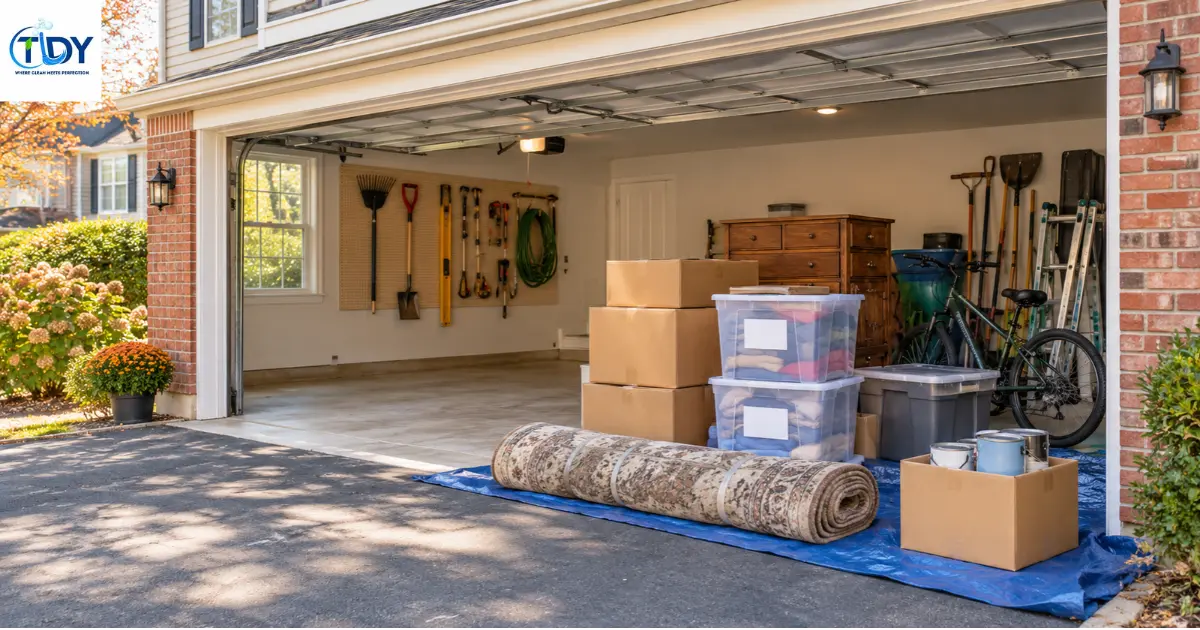
Sorting goes faster when every item has somewhere to go the moment you pick it up. Start by clearing a staging area. In a garage, empty one bay or a section of the driveway first. For an attic, stage in the hallway or room under the hatch so nothing is sorted on the ladder. In a basement, stage near the bottom of the stairs and carry things up in loads you can manage.
Keep, Donate or Sell, Recycle, Trash, Relocate
Set up five piles, boxes or tarps, each with a big label:
Keep: used in the last year, or it fits the goal you set.
Donate or sell: works, and someone else would use it.
Recycle: cardboard, metal, electronics.
Trash: broken, moldy or past saving.
Relocate: belongs in another room of the house.
The relocate pile is the one most guides leave out. Without it, the kitchen mixer and the spare towels go back on the garage shelf because there was nowhere else to put them. If the five-pile idea works for you, our whole-home decluttering framework uses the same thinking for the rest of the house.
Quick Rules for the Hard Decisions
Most of the time goes into the items you can't decide on, not the obvious ones. These rules, borrowed from people who've done this many times, keep things moving:
Broken for more than a year? It isn't getting fixed. Let it go.
Stored for someone who doesn't live here? Give them a date to collect it.
Hobby gear untouched for about three years? Schedule the hobby or pass the gear on.
Duplicates? Keep the best one.
Boxes unopened since you moved in? Open each one once, then decide.
For furniture and other big pieces, a strip of painter's tape marked keep, go or ask saves a lot of back-and-forth, especially when more than one person is deciding.
Set Aside Hazardous Items Before Anything Gets Hauled
Some garage and basement leftovers can't go in your regular trash or in a junk hauler's truck. Pull these into their own box before any loading starts:
Oil-based paint, stains, varnish and thinners
Pesticides, herbicides and old fertilizer
Pool chemicals, motor oil and other automotive fluids
Propane tanks
Rechargeable batteries and fluorescent bulbs
Electronics (TVs, computers, cords)
Household hazardous waste (HHW) is any leftover product that's toxic, flammable or corrosive. Fairfax County takes it from residents for free at two sites: the I-66 Transfer Station at 4618 West Ox Road in Fairfax, and the I-95 Landfill Complex in Lorton. The drop-off days are not the same. As of November 2026, the I-66 site is closed for hazardous waste on Wednesdays, and the I-95 site accepts it only on Wednesdays and Saturdays. Check Fairfax County's current hours for both sites before you load up.
Two rules from the county's household hazardous waste brochure catch people out. Bring items in cardboard boxes, not plastic bags. And asbestos isn't accepted at either site. Latex paint is handled differently from HHW: a can that's less than a quarter full can be left open to dry and then go out with the trash.
For the full list of what a hauler can and can't take, and where refused items go, see our guide to what junk removal can and can't take in Fairfax County.
Space-by-Space Tips
The seven steps stay the same, but each space has its own problems. A garage is mostly about room to work, a basement about moisture, an attic about heat and footing.
Garage
Empty one bay completely before you start sorting the rest. That bay becomes your sorting floor, and it shows you how much space you're actually working with.
Protect the path before anything heavy moves: open the garage door fully, pull the cars out, and keep a clear walkway to the driveway. Then check the shelves. Garages collect old fertilizer, weed killer and half-empty automotive fluids, and all of it belongs in the hazardous box.
Don't forget the space overhead. Rafters and ceiling racks hide a surprising amount, and those items need a stable ladder and a second person to bring down. Bikes, ladders and long-handled tools take up far less floor when they hang on the wall. Watch for chewed cardboard or droppings as you go. Mice like garages, and boxes on the floor are an easy home for them.
Basement
The most useful basement cleanout tips come down to light and moisture. Bring in more light than you think you need. Dim basements slow sorting down and make the job feel worse than it is. Run a dehumidifier while you work, and wear a mask around water-damaged cardboard.
Anything that's been wet for a while, especially paper, fabric and cardboard, usually goes. Keep the stairs clear and carry loads you can see over. Leave clear space around the furnace and water heater, and don't stack boxes against them when things go back. Before you put anything back, look for water stains on walls and floors so you know whether storage boxes will stay dry.
Attic
If you're working out how to clean out an attic safely, the best way is in short sessions early in the day, with one person in the attic and a helper below the hatch. Pass boxes down rather than carrying them on a pull-down ladder, where you need both hands.
Stay on the floor joists or the floored area. Insulation between the joists won't hold your weight, and the ceiling below it is usually thin drywall. Watch your head too: roofing nails often poke through the roof deck above. Before you move anything, look at the insulation. If you see loose, pebble-like material that's gray-brown or silver-gold, stop and read the safety section below.
When things go back up, put the items you reach for every year, like holiday decorations, closest to the hatch.
Safety: When to Stop and Call a Specialist
Most cleanouts are dusty, tiring work and nothing more. A few situations are different, and these are the points to stop.
Mouse droppings. The CDC's guidance on cleaning up after rodents is clear: don't sweep or vacuum droppings, urine or nests, because that puts particles in the air. Wear rubber or plastic gloves, spray the area with a bleach solution or an EPA-registered disinfectant until it's very wet, let it soak about five minutes, then wipe it up with paper towels. A heavy infestation is a job for pest control.
Vermiculite insulation. The EPA's guidance on vermiculite insulation says to leave it undisturbed, because it may contain asbestos. It also advises against storing items in an attic that has it. If it has to come out, that's work for a trained asbestos professional.
Mold or water damage. A few spots on a box are one thing. Mold across walls, ceilings or a large area needs a remediation specialist, not a cleanout crew.
Heat, wiring and footing. Keep attic sessions short and keep water nearby. Don't touch exposed wiring, and keep children and pets out of the work area.
Getting Rid of It in Fairfax County: Your Options Compared
Once the piles are sorted, everything leaving needs a way out. The right option depends on how much there is, how heavy it is and how you get your trash collected.
Option | Best for | Effort | Things to know |
|---|---|---|---|
Drive it to I-66 or I-95 yourself | Anyone with a truck or SUV and a few loads | High: loading, driving, unloading | Most recyclables are free; trash is charged by weight or bag count. See the county's current disposal rates. |
County special pickup | Homes on Fairfax County trash collection | Medium: you move it to the curb | Only about 10% of homes are county collection customers. They get five free special pickups a year, scheduled ahead. Everyone else should check with their private trash company. |
City of Fairfax curbside | City of Fairfax residents | Medium | The City runs its own curbside collection, including large items. |
Donate | Furniture, tools and household goods in working order | Medium: drop-off or a scheduled pickup | Habitat for Humanity ReStores in Chantilly and Alexandria take donated furniture, appliances and building materials. Check what each charity accepts before you load the car. |
Hire a junk removal crew | Heavy items, stairs, large volume, a deadline, no truck | Low: you point, they lift | Loading, hauling, recycling and disposal are handled for you. |
County special pickups are limited to two cubic yards each, a pile about six feet long, three feet wide and three feet high. A full garage is usually several times that.
The more of the job is heavy lifting, stairs and trips across the county, the more a crew makes sense. Our garage, basement and attic junk removal team handles the carrying and the disposal, and we sort out recycling and donations with you item by item.
If You Hire Help: How to Prepare for a Junk Removal Crew
You don't need to pre-sort everything before a crew arrives. Mark what stays, make the space reachable and let the crew handle the rest. Doing too much yourself just means carrying things twice.
Do:
Mark everything you're keeping with painter's tape or a "KEEP" sign.
Pull out valuables, papers, keys and medications.
Set the hazardous box aside so it doesn't get loaded by mistake.
Clear the driveway and the path to the space.
Take photos of the whole space, plus the way out: stairs, the attic ladder and any tight turns.
Don't:
Drag heavy items to the curb yourself. That's what the crew is for.
Clean first. Cleaning comes after the space is empty.
What affects the quote is mostly volume, heavy or bulky items, stairs and carry distance, and the type of items. With us, estimates are free, photo quotes are welcome, there's no minimum charge, and the quote explains how and why the price could change. You can be there or give access, whichever you prefer.
Not sure it's a DIY job? Send photos for a free estimate and we'll tell you what it would involve.
After It's Empty: Clean Before You Put Anything Back
An empty room is the best chance you'll get to clean it properly, so do it before anything goes back in. Work in this order:
Wet-clean any droppings first, using the CDC method above.
Sweep, then shop-vac the corners, shelves and beams.
Wipe down shelves and surfaces.
Mop or rinse the garage floor if it needs it.
In a basement, run the dehumidifier for a day before restocking.
While the space is bare, look for water stains, gaps where pests get in, and leaks around windows and doors. They're much harder to spot once the shelves are full again.
When we do a cleanout, our crew cleans the cleared space before leaving, so you don't need a second appointment for the dust and debris left behind. When the rest of the house is due too, we also offer deep cleaning for the rest of the house.
Put Back Less, and Keep It That Way
Put back only what fits the goal you set at the start. Many people who do this regularly aim to return about half of what came out.
Use clear lidded totes instead of cardboard. Cardboard soaks up moisture and gives pests somewhere to nest.
Label the side of each tote that faces out.
Store heavy items low and light seasonal items high.
Keep what you use most closest to the door or the hatch.
A few things don't belong in a garage or attic at all: paper photos and documents (heat and humidity damage them), food that draws pests, and open containers of chemicals near heat. Keep propane tanks outdoors, following the label.
After that, keep it simple. Do a quick check each season, and when something new comes in, something old goes out. If you'd like a hand setting up a system, we offer help organizing what you keep.
Common Cleanout Mistakes
Trying to do the garage, basement and attic in one day
Moving clutter from the attic to the garage instead of out of the house
Letting the donate pile sit in the garage for weeks
Skipping the hazardous box and finding paint cans in the trash bag
Sweeping up mouse droppings instead of wet-cleaning them
Buying bins before sorting, then buying the wrong size
Putting everything back because it all fit before
FAQs
What is the 12-12-12 rule for decluttering?
The 12-12-12 rule is a popular decluttering method: find 12 items to throw away, 12 to donate and 12 to return to where they belong. It works well as a warm-up for a big cleanout or as a quick reset once a month. It won't clear a packed garage on its own, but it builds the habit of deciding quickly.
How long does a garage cleanout take?
It depends on volume, how easy the space is to reach, how quickly you can make decisions and how many trips the leftovers need. A packed garage, a damp basement or an attic reached by a pull-down ladder often takes more than one weekend if you're doing it yourself.
Can I put everything at the curb on trash day?
Usually not. Large and bulky items need a separate collection. Fairfax County collection customers can schedule a special pickup, City of Fairfax residents have their own curbside service, and most other homes need to check with their private trash company. Hazardous items never go to the curb.
What happens to items that can still be used?
We talk it through with you item by item. Usable things can be set aside for donation, recyclable materials are recycled, and only what's left goes for disposal. Let us know when you book if there's anything you want to go to a particular charity.
Ready to Get Your Space Back?
Tidy House Keepers is a family-owned business serving Fairfax County, VA since 2022. We're fully licensed, bonded, and insured, and all team members undergo background checks. Flexible scheduling is available, including same day or next-day. We haul it away and clean the cleared space before we leave. New customers get $30 off their first service.
Send photos for a free estimate or call (202) 790-1006. You can also read more about our junk removal service.
